Visiting Kotla Mubarakpur Complex in Delhi

If you want to dig into India’s past and see some truly off the beaten path sites, visit the Kotla Mubarakpur complex in Delhi.
The urban village of Kotla Mubarakpur and surrounding South Ex neighbourhood have remarkable monuments from the Lodhi and Sayyid eras. These monuments are spectacular, but almost completely forgotten.
Kotla Mubarakpur Complex in Delhi
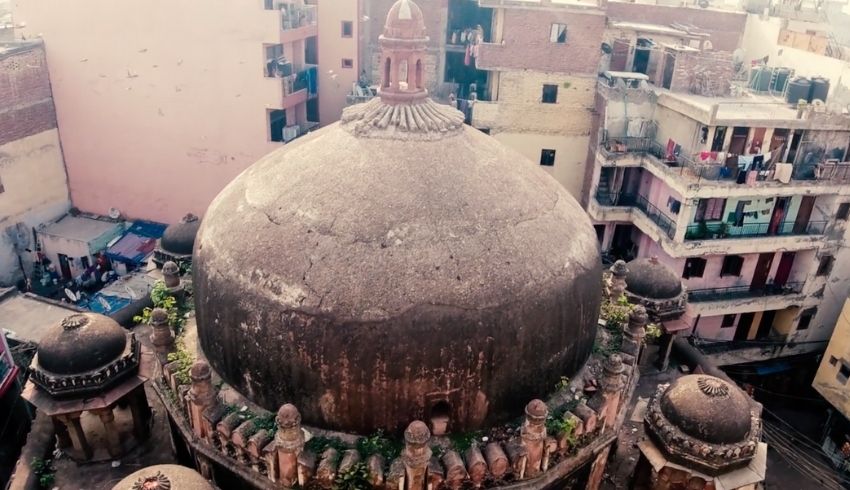
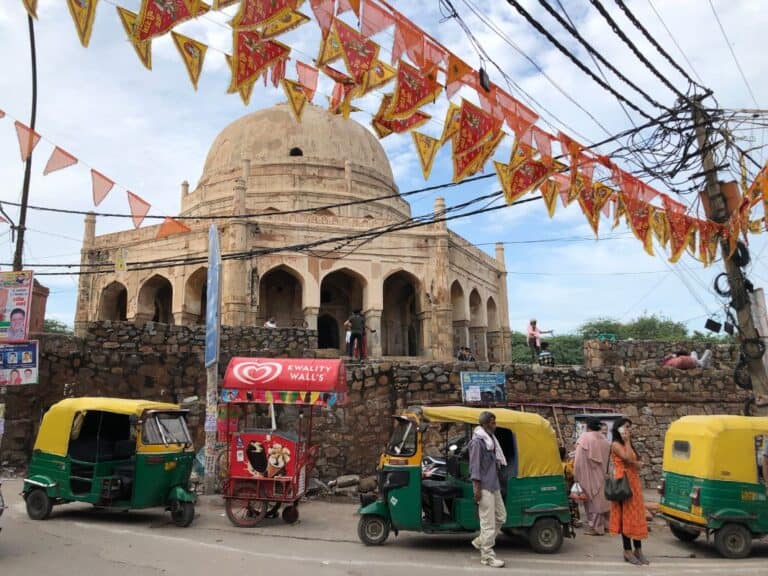
Several monuments are protected in a park like setting among apartment and commercial buildings, but others are in the middle of the urban village, practically swallowed up by encroaching construction.
I’ve heard there are even more tombs in the village, but they can’t be seen from the streets, only from elevated vantage points as they are completely enclosed by new construction.
Some of these tombs may be locked, but for a small tip the watchman or caretaker will usually be happy to unlock them and show you around.
Hours: 24/7, but go during daylight
Cost: Free
Location: Kotla Mubarakpur, South Extension, New Delhi
Where are the Kotla Mubarakpur Monuments?
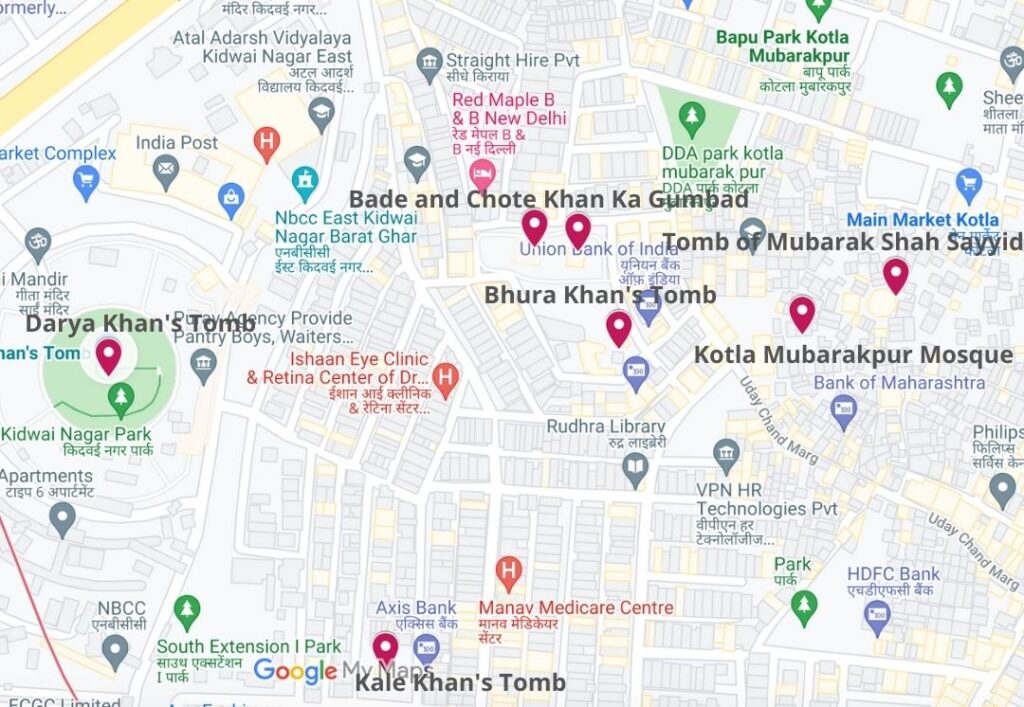
The Kotla Mubarakpur tombs are located in South Extension I (commonly called South Ex), a residential neighbourhood in South Delhi. The tombs are a little spread out, but walkable from each other.
Several are in the urban village of Kotla Mubarakpur (part of South Ex), and will require trekking through a warren of back lanes and alleys. It can be confusing, but use this map to help you (same map as above).
How to Get There
The best way to reach the Kotla Mubarakpur Complex is by metro or Uber. The nearest metro station is South Extension (Pink line, exit Gate 1). The Delhi metro and Uber are both reliable.
If you take an Uber, get the driver to drop you off at Darya Khan’s tomb, and walk to the rest from there. This is the easiest tomb to find.
If you take the metro you can easily walk to Darya Khan’s Tomb. That’s the closest one to the South Extension station and a logical place to start.
History of the Kotla Mubarakpur Complex
The complex is named after Mubarak Shah Sayyid, who ruled as part of the Delhi Sultanate in the early 1400s. All of the structures were built in the 15th and 16th centuries.
The complex is built in typical Indo-Islamic style, featuring octagonal tombs with many arches and domes. They are mostly constructed of red sandstone, plentiful at that time.
While the village of Mubarakpur was established in the 1400s, South Ex was developed in the 1960s. Like so much of Delhi – some of the existing monuments were razed to make way for the new construction, while others were saved.
Darya Khan’s Tomb
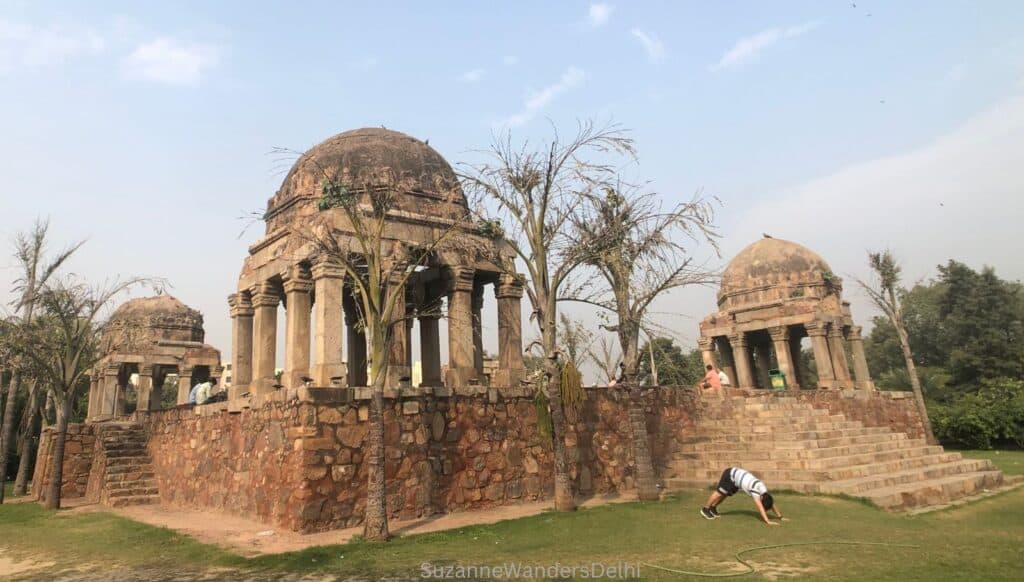
This Lodhi era tomb used to be in the middle of a busy traffic island, only accessible via a pedestrian overpass. When the area was redeveloped for additional housing, the monument was given a park like setting including a jogging track installed for residents.
The tomb was constructed in the early 16th century using a three-tiered design, which is the only one of this kind in Delhi. There are three domed pavilions, and Darya Khan’s white marble tomb lies in the very centre on an open platform.
Darya Khan Lohani was an important figure during the Lodhi period, serving as chief justice and court advisor. Local residents treat Darya Khan as their family saint and offer sweets and incense at his tomb on Thursdays.
Bade and Chote Khan ka Gumbad
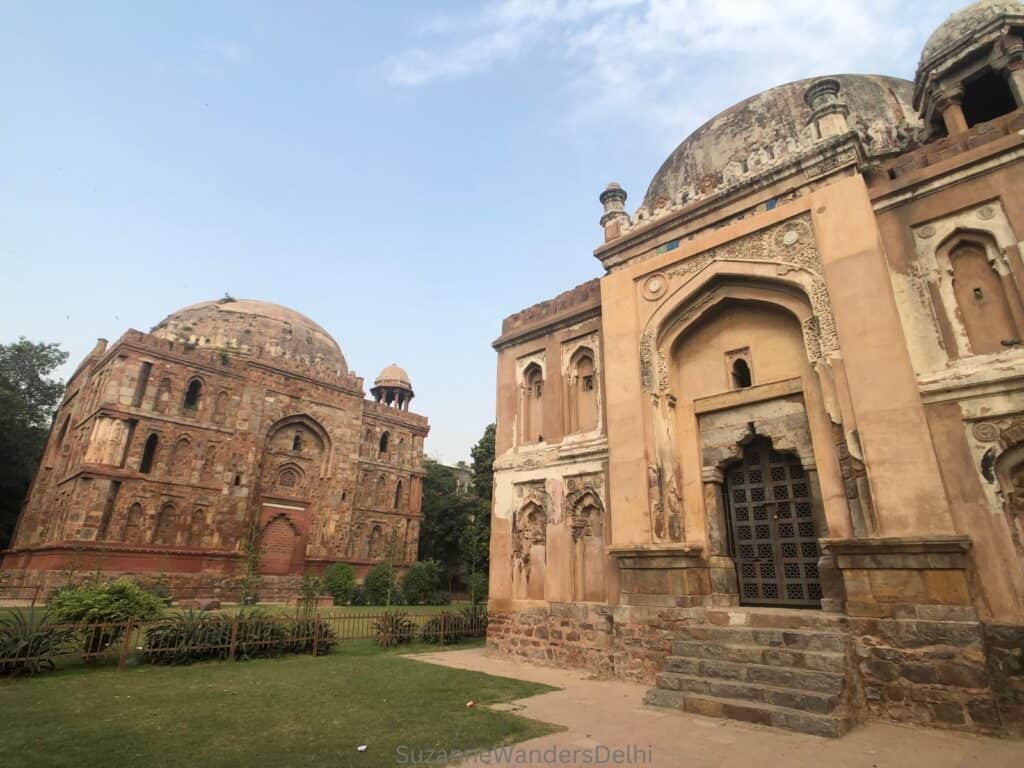
These are a set of two spectacular tombs that barely get a second look, even though they are in relatively good condition and located in a prominent area.
Bade (Hindi for ‘big’) Khan ka Gumbad is the larger of the two. It has three levels of niches and typical Lodhi era octagonal, domed turrets. Chote (Hindi for ‘small’) Khan ka Gumbad is the smaller tomb and blue tile work is still visible on the facade.
Little is known about the tombs, other than they were built in the 16th century and are probably related in some way. It is likely they were for noblemen.
Bhura Khan’s Tomb
Almost nothing is known about this small tomb, but it is only a few metres away from Bade and Chote Khan ka Gumbad and worth a look.
Kale Khan ka Gumbad
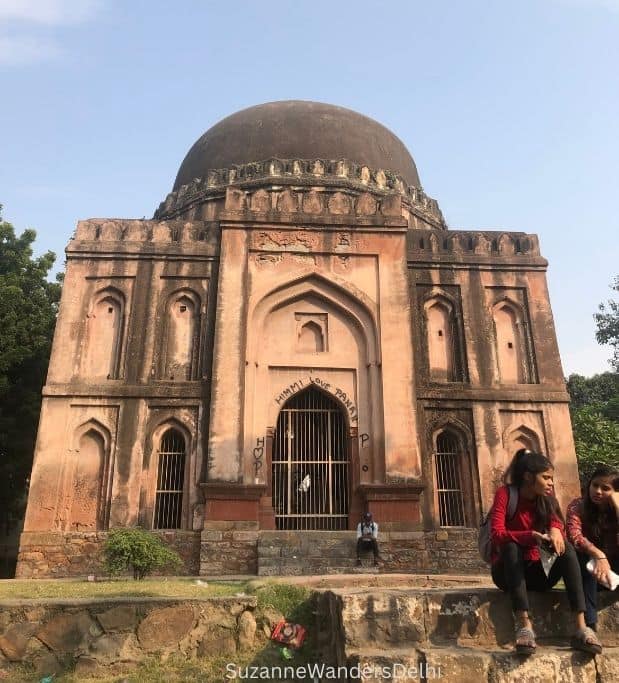
This is the earliest of the Lodhi era tombs. An inscription on the mihrab (carved niche facing Mecca) inside the tomb confirms it was built in 1481.
It may be the tomb of Mubarak Khan Lohani, father of Darya Khan Lohani, but it is not known for sure. The name means ‘tomb of the black Khan.’
Mubarak Shah Sayyid’s Tomb
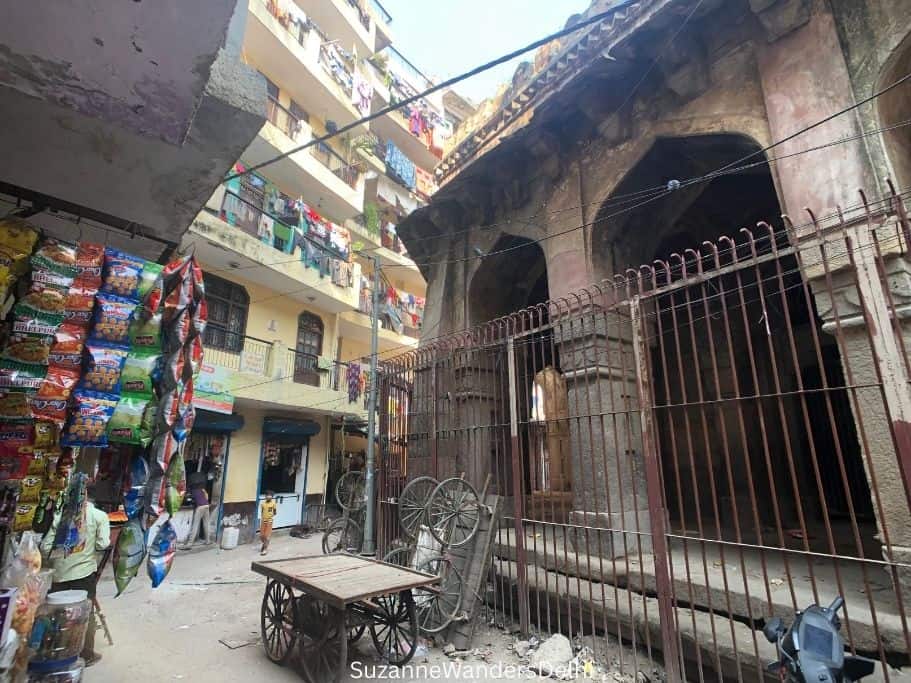
Mubarak Shah was the second ruler of the Sayyid dynasty which ruled Delhi from 1414 to 1451. He was a successful ruler and fended off many foreign invasions. Kotla Mubarakpur is named after him.
His tomb is one of the most off the beaten path sites in Delhi, located deep in the urban village of Kotla Mubarakpur.
Unfortunately, it is a classic example of uncontrolled building and encroachment putting these historic buildings at risk, which is typical in Delhi’s urban villages.
At one time the tomb must have been a fantastic site, judging from the architecture. Today, it is difficult to even locate in the jumbled lanes and buildings that have sprung up completely surrounding it. You will have to go down the narrow alleys to find it.
Kotla Mubarakpur Mosque
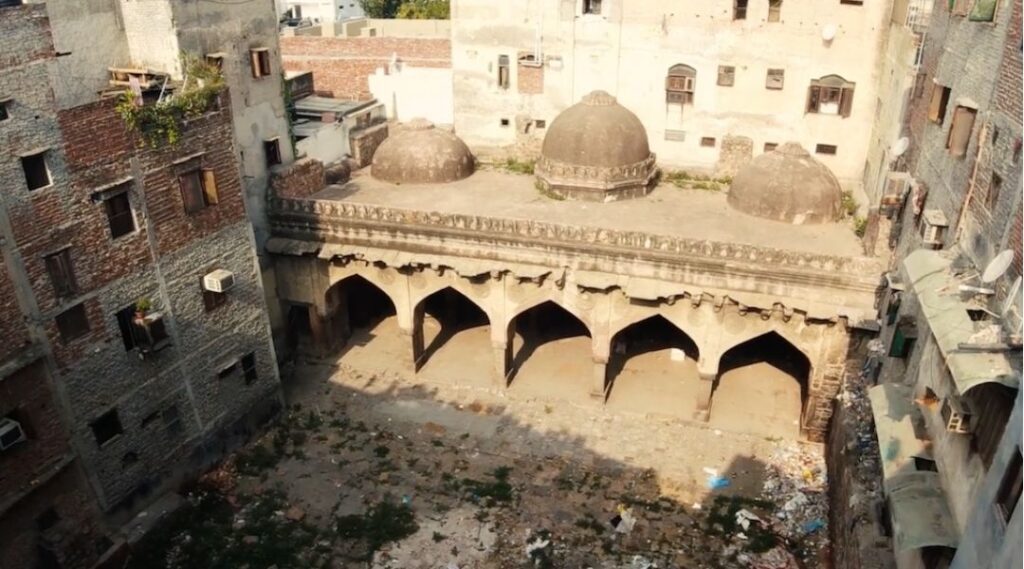
At one time the Kotla Mubarakpur mosque would have been adjacent to Mubarak Shah Sayyid’s tomb, but today there is a chaotic maze of structures between the two.
Illegal construction has completely encroached upon the mosque, even touching its exterior walls. The courtyard is regularly used as a playground, a place to tie up cows and garbage dump.
I heard recently that new construction has completely closed off access to the mosque. I plan to re-visit it on my next trip to Delhi, but until then I can’t say if you’ll be able to access it or not.
The mosque is not far from the tomb of Mubarak Shah Sayyid, again through the narrow alleys.
What Else to See Near Kotla Mubarakpur Complex
There are plenty of sites in South Delhi, and I recommend the following ones that are close to Kotla Mubarakpur Complex. The easiest way to reach any of these is by auto rickshaw.
- Defence Colony Market: Neighbourhood market in upscale Defence Colony. Lots of restaurants (Amici Cafe and Sagar Ratna are good).
- Masjid Moth: Impressive Lodhi era mosque built between 1505 and 1510.
- Dilli Haat INA: An open air, pedestrian zoned cultural and handicraft market. Excellent variety and wonderful outdoor food court.
- Lodhi Art District: Quiet residential area with over 50 art murals, very nice.
Where to Stay Near Kotla Mubarakpur Complex
These are very good hotels and guest houses not far from Kotla Mubarakpur Complex. They are all located in South Delhi, the nicest and safest part of Delhi to stay in.
- The Leela Palace (luxury): Very best 5 star hotel in Delhi. Located in the Diplomatic Enclave and very central for sightseeing.
- Lutyens Bungalow (mid-range): Heritage boutique property in one of the best areas of the city next to Lodhi Garden.
- Prakash Kutir Bed & Breakfast (budget): Family run guest house in a very good area of South Delhi.
Last Words on Visiting Kotla Mubarakpur Complex in Delhi
Exploring the tombs in Kotla Mubarakpur Complex isn’t always easy, but that’s exactly the appeal. Wandering these forgotten tombs, half-hidden by built-up Delhi, is like stepping into a fragile layer of the city’s history. They are quietly surviving in the modern city, waiting for intrepid visitors to seek them out.